



Mary Jane Minkin, M.D. is a board-certified obstetrician/gynecologist in private practice in New Haven, Connecticut, and a Clinical Professor of Obstetrics and Gynecology at Yale University School of Medicine. She is a lead author and co-author of articles in numerous peer-reviewed journals, including Obstetrics and Gynecology and Journal of Reproductive Medicine, as well as co-author of A Woman’s guide to Sexual Health (Yale University Press, 2005).
The job of a gynecologist is to help keep women from getting pregnant when they don’t want to be pregnant, and to help them conceive when they want to have a baby. If 100 couples have regular intercourse, say every other day, for a month, by the end of that month of trying to conceive, at most 20 will be pregnant. By the end of six months of trying, 50 will be pregnant, and by the end of one year, 80 will be pregnant. Therefore, gynecologists usually recommend to young couples (women under the age of 35) to try for a year before starting infertility evaluations.
Trying to conceive can be a very stressful time for couples. For many, conception is the first thing that has been out of their control, and couples feel pressured to have sex at the exact time of ovulation, whether or not they are in the mood. When not in the mood and dealing with other external stressors, many couples experience discomfort with intercourse, related to a lack of lubrication. Studies have shown that a significant number of couples trying to conceive report that sexual intimacy is negatively affected because of vaginal dryness, with a majority experiencing at least occasional episodes. It’s for this reason that many couples purchase lubricants as a solution to reverse the effects of vaginal dryness.
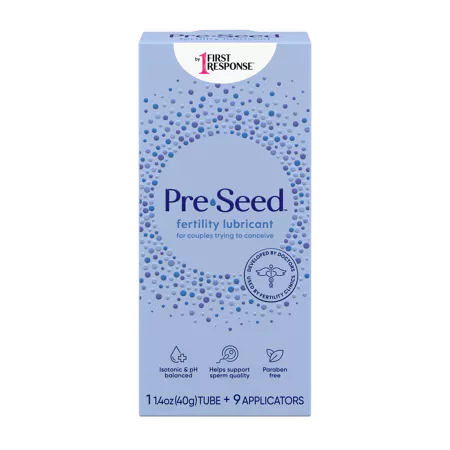
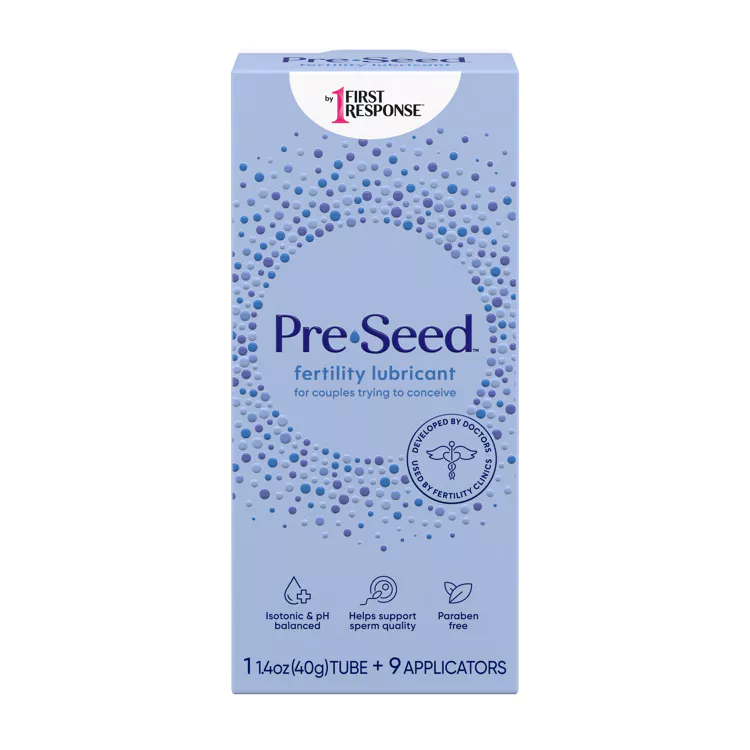
Most women are aware of lubricants for sex, but many are unaware that most lubricants can adversely affect sperm by killing or substantially slowing down their motility. To help counteract these negative effects sperm, a Ph.D. researcher in sperm physiology developed a vaginal lubricant, called Pre-Seed™.
In a study published last year in Fertility and Sterility (Volume 101, Issue 4, April 2014, pages 941-944), researchers at SUNY Upstate Medical Center in Syracuse, New York, devised a model to study sperm from many different healthy donors. This model mimicked the environment in which an egg is fertilized. They then studied the sperm and exposed it to a few different types of lubricant. They confirmed that Pre-Seed™ Fertility-Friendly Lubricant had no significant adverse effects on the health and motility of sperm, whereas other commercial lubricants evaluated in the study, including some Astroglide and KY products, had significant deleterious effects.
Since it is common for couples to experience dryness and discomfort with intercourse, many gynecologists now recommend Pre-Seed lubricant to alleviate these problems. If you and your partner’s sexual intimacy has been negatively affected by vaginal dryness, I would urge you to speak with your gynecologist to confirm if Pre-Seed™ Fertility-Friendly Lubricant is the best alternative for you.